Tuesday, November 15, 2022

Recommended posts from elsewhere: Red light politics

 Hear, hear! This is not a new post, but still evergreen. 

Do NOT debate another person or group's humanity. That is NOT up for debate. 


https://redlightpolitics.info/post/65432741342/why-i-dont-debate

Sunday, March 13, 2022

Silence

 No, I don't mean my shocking lack of consistency in writing blogs. (I have ideas, which I have even jotted down somewhere. It doesn't help if I don't develop those ideas. It doesn't help if I am not sure where I wrote down the ideas. I give myself credit for persistence if nothing else). 

This is about grief. 

My Dad died in January. Suddenly and rather brutally. Violently actually. There was no one else involved, but he slipped on ice and hit his head. Very badly. He and I disagreed about many things important to both of us, but he was my Dad and for his weird political ideas he was an amazing Dad. Nothing like death to make one realise that. I am also so grateful that we had a good Christmas together where there were no political discussions. Also while he gave the rest of the family cryptocurrency as a gift, he didn't give to me, and that moment I will cherish. For the first time in my life I actually felt as though he knew me. So anyway, I am mourning him, and I feel a lot. I am the female version of him in that sense. 

I recently bought a book of poetry about grief and it is lovely. Not every poem speaks to me of course. 

This one did though. My world is definitely quieter without my Dad. 

Rest well, Daddy.


   (blogger's own photo)  

Silence

by D.H. Lawrence

Since I lost you, I am silence-haunted; 
    Sounds wave their little wings 
A moment, then in weariness settle 
     On the flood that soundless swings. 
 
Whether the people in the street 
    Like pattering-ripples go by, 
Or whether the theatre sighs and sighs 
     With a loud, hoarse sigh: 
 
Or the wind shakes a ravel of light 
    Over the dead-black river, 
Or last night’s echoings 
     Make the daybreak shiver: 
 
I feel the silence waiting 
    To sip them all up again,
In its last completeness drinking
    Down the noise of men.

Young, Kevin. The Art of Losing (p. 15). Bloomsbury Publishing. Kindle Edition.

Thursday, November 25, 2021

The joke is on me

I am so bitterly disappointed. 

I have always dreamed of the moment when I could breathe, and take the time to sort out all the thoughts and ideas accumulated during a 20 year long career to write a doctoral thesis. Especially after the last two years where I feel as though I was continually faced with enormous political conundrums which I was not equipped to face except as part of a team. I was part of a team, but almost none of them had any experience in my field, so I spent too much time educating them. 

So now, I was finally going to have the breathing space to think through and find solutions and evidence. 

Instead I am still being forced to write things I have not had the time to reason through. Distressed may be a good word for it actually. Because at this point, if it were feasible, I would love to give up. And that just makes me sad. I am living my dream and I am miserable. 

So, as I said. The joke's on me.

via GIPHY

Friday, November 5, 2021

New adventures, old ghosts

Well, things have changed.

Been wondering whether I would be able to give a new life to this blog. 

For one thing, I am now a PhD fellow. I am very excited, as I am not exactly a spring chicken no more, and this has been a dream since I finished my undergraduate degree in the nineties. (As I said, I am no spring chicken). The opportunity also conveniently put an end to a work situation which was slowly but surely wearing me down. 

It is a challenge, and I have had instances when I have been despondent, realising that I need to be more realistic in my ambitions. I also wonder if I can write something which will be truly interesting and, even better, actually useful. Otherwise, what is the point? I guess time will tell. Now that I am able to give in my overthinking intellectual self, I am also working through what kind of faith I want to have. I do want to have a faith, the alternative is too dreadful to contemplate. That feels like something I can write about. 

So, while this is in some respects the tail end of 2021 (thus proving even if you move from the Southern Hemisphere, the Southern Hemisphere never leaves you), it is also a time for beginnings. 

So as my sweetie turned a year yesterday (teen in the house?), here's to new adventures, and old ghosts.


Monday, May 17, 2021

Language musings

So it has been a quiet year blogwise so far. 

Not really otherwise though. Year two of the pandemic and I am on the cusp of my PhD adventure. I have a fair amount to do in that respect, but why rush?

Of course the biggest adventure of all so far this year is Leozinho. Now six months and a while to go until he is fully grown, but definitely in the pleasant part of the experience. (The first few months were harder than I anticipated). 

But the actual topic for this post is to mull over a segment I heard on a podcast I have recently discovered. It is a Norwegian and called Språksnakk, not to be confused with Språktalk (another podcast I have been listening to for longer). 

Anyway, in yesterday's show a listener had sent in a question around the Norwegian phrase "ærlig innrømme". The key point was that innrømme is to admit something, and so the association is quite counterintuitive: how does one admit anything other than honestly? A tautology of sorts. 

What I found disappointing about the response was that there was no reference to English. Rather the expert spoke of the emergence of the phrase "ærlig talt". Now I am no linguist, to be sure. but as someone fluent in both English and Norwegian, it seemed to me that it is in fact a Anglicization.  Ærlig talt is not a tautology in the same way in Norwegian as ærlig innrømme

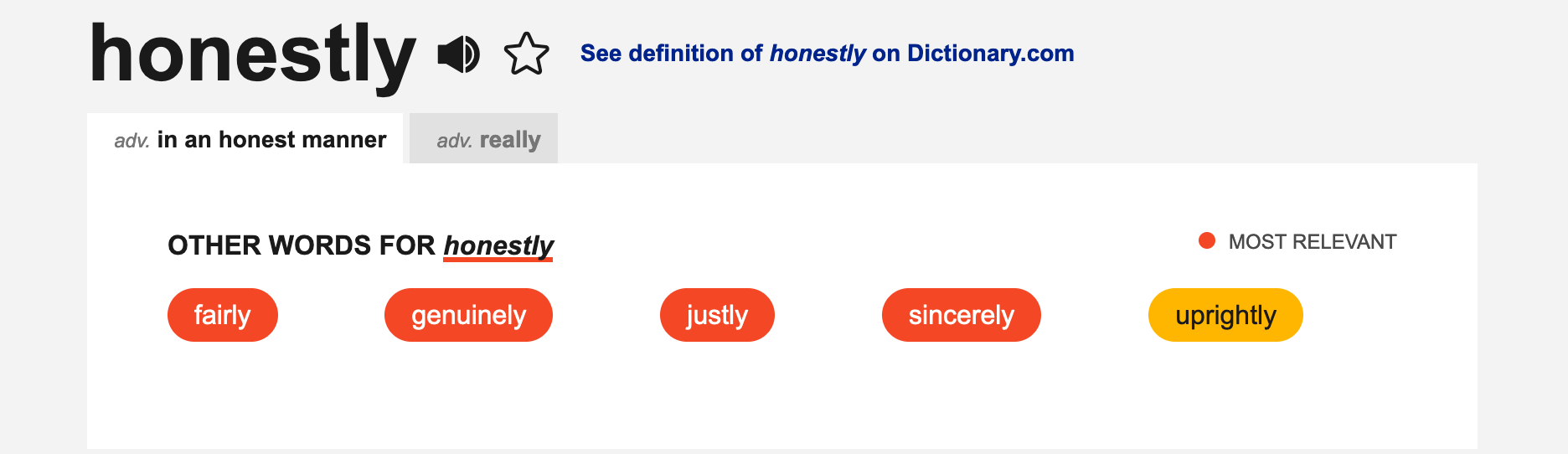
But if one considers that the word "honestly" in English can be a synonym colloquially for sincerely (as confirmed by my screenshot from thesaurus.com, then it could be argued that the point is not about honesty as much as sincerity. 

My take, for what it is worth.


Friday, January 1, 2021

The literary year 2020

Thank goodness, 2020 is done. 


Not that I believe 2021 will be back to normal (whatever that may be). The only thing I wish for is that it is not worse than 2020. Or at the very least, the beginning of the post-COVID-19 world. 


I wrote little in 2020. As is my wont (or lack of wont) when things are a bit overwhelming. However, as it also quite common, one starts the year by wanting to get back on track. A new year is as good a point as any to pick up threads again. So here I am. To ease into things, I thought I would write an easy post about my book-year 2020. 


I like lists, and keep lists of the books I read. Several lists. One is a list of books I read per year, one is my personal reading challenge (a useful tool to help me choose books, otherwise I struggle to choose). I also have a list of all books that I have ever read (as far as I have been able to recall); books by genre; books by award; and finally keep track of reading books in series or with common characters in order. I am also on Goodreads and enjoy the annual Reading Challenge there.


Yes, I like lists.

So, according to my own list, I read 131 books last year. According to my Goodreads challenge in 2020, I read 139 books. The discrepancy is due to registering novelettes online, but not on my personal list. My goal was only 100 books, but unlike an earlier year, I did not update the challenge when I reached that goal. 


In 2020 I read 73 books written by women and only 56 books written by men. I long assumed that I read more books by women than men, but when I actually counted, I found that I in fact read slightly more by men than women. That had to be remedied. I also made a concerted effort to read more translated and non-Western European authors. I read books in three languages last year - English, Norwegian and Swedish (the latter purely in audiobooks).


More specifically about books that I read last year: 


First book finished: Let it bleed by Ian Rankin.


Last book of the year: A Bali conspiracy by Shamini Flint.


Best books I read: The keeper of lost things by Ruth Hogan; Be the Bridge by Latasha Morrison; The monster at our door by Mike Davis; The riddlemaster of Hed by Patricia McKillip; Odinsbarn by Siri Pettersen.


Re-reads I loved: Taken at the food by Agatha Christie and The furthest shore by Ursula K. le Guin.


Book that surprised me: The keeper of lost things by Ruth Hogan; The lamb will slaughter the lion by Margaret Killjoy; Norge - et lite stykke verdenshistorie by Stian Bromark & Dag Herbjørnsrud; The city & the city by China Miéville; The stars are Legion by Kameron Hurley; River of teeth by Sarah Gailey; The Gurkha and the Lord of Tuesday by Saad Hossein; Hyttebok fra helvete by Are Kalvø and A man of repute by Elizabeth Edmondson.


Most challenging book to finish: Norge - et lite stykke verdenshistorie by Stian Bromark & Dag Herbjørnsrud.


Most decorated books (most literary prizes): The city & the city by China Miéville (six prizes, two shortlists and one longlist) and Every heart a doorway by Seanan McGuire (three prizes).


Number of authors I had never read before: 62


Of these, authors I look forward to reading more of: Elizabeth Edmondson, Ken Liu, Siri Pettersen, Patricia A. McKillip, Alex Gray, Martha Wells, Frank Aarebrot, Adrian Tchaikovsky, Fredrick Backman, Samantha Schweblin, Sarah Gailey, Kameron Hurley, Maria Turtschaninoff, Malin Persson Giolito and Margaret Killjoy.


Number of audio-books:  45


Books that disappointed (and that I nevertheless finished): 3001: The final odyssey by Arthur C. Clarke and The ascent of money by Niall Ferguson.


Number of books I started by didn't finish: 38. (These include some I will most likely finish in the future. One which stands out is the award winning The goldffinch by Donna Tartt, where I shared the view of a writer on electricliterature.com that the pre-Vegas part of the book is lovely, after that, I got bored). 


Making this post was considerably more challenging than before. This is my reward for not following the changes to Blogspot closely enough I suppose. 


Well, here is to a good literary year 2021, no matter what else happens. 


Oh, and happy new year! Keep safe, healthy and a good book close.


Sunday, September 6, 2020

How much longer?

Forgive me, reader, for it is a while since my last blog. 

In my defense: it has been quite a year, no? The hits just keep coming. As if the pandemic in a post-truth and science-sceptical era is not bad enough, democracy is being dismantled in the US, brick by brick, even as mamy white USians finally seem to realise that unless they do something, the disproportionate deaths of Black men in particular, will continue. I can name all too many names: Tamir Rice, Rekia Boyd, Atatiana Jefferson, Alton Sterling, Eric Garner, Trayvon Martin, Michael Brown, Philando Castile, Sandra Bland, Akai Gurley, Walter Scott, and the list goes on. 

This year, we have George Floyd, Breonna Taylor, Jacob Blake and many, many more. 

Most recently (among the better known) Daniel Prude.

WHEN WILL IT END??

At any rate, I was listening to a podcast (Poetry Magazine) and this was the poem they were discussing. Written by a Yankunytjatjara Aboriginal poet. The discussion was simply annoying, especially the point when they see the rope being pushed under the door as "blind justice". WTF? There is no justice here. Nor is there with the all to common ubiquitous execution at the hands of US police with impunity. A definite candidate for decolonisation. I would like to think the discussion would be different now.

Read, and consider. 


source: Poetry Foundation  (accessed today)


Friday, May 22, 2020

Am I an African?


Peter Tosh sings that as long as you are a black man, you are an African, no matter where you are otherwise "from". The song came up on my random music feed on iTunes and got me thinking.

I was born and raised on the African continent and have spent the better part of my life there. I lived my formative years there, and yet am I African? I am not entirely European, other than by appearance. It is complex. The term Euro-African is useful.

What I am reminded of when the question comes up, however vaguely is when I was living in Nairobi, it was my privilege to be able to hear Ngũgĩ wa Thiong'o speak. I forget the exact phrase, but what he said was along the lines that you never forget where you are from, that place forms who you are.

Whether I am African or not in the eyes of all, Africa and my efforts to deconstruct my whiteness as a white South African is probably the most significant part of who I am.

I am profoundly grateful for that and I like who those experiences have made me. I do not know what it is like to like who you are without having to put in work. I suspect that I, and those who like me who understand what the means are the richer.

Thursday, April 9, 2020

An analogy for our times

So like most of the world, I have been in social isolation at home. This has entailed working from home for three weeks (and counting). Other than that, my life is remarkably similar to the norm. Well, perhaps I am actually engaging with friends more than normal. Anyway, been doing the usual to get through the days: read, knit (after a break of a few weeks), and watching online TV.

Yesterday I watched three movies. An old thriller I remember enjoying, with Michael Douglas, "Don't say a word". It was as good as I recall, one of the movies I have actually seen on the big screen. I saw that as someone who has never been a particular movie goer, the last movie I saw in an actual cinema was Star Wars: the last Jedi. That should tell you a lot. The other two movies were the Denzel Washington movies Equalizer and Equalizer two. A bit violent for my taste, but I am such a fan of Washington and needed to see the bad guys get what was coming to them, so to speak and I persisted.

On one level it was a fairly typical, tried and true recipe. In the first movie, the foreigners, in the second, the local bad guys. It was a bit surprising as one didn't exactly get to know the character Robert McCall particularly well. Entertaining enough.

The analogy of our times though, which I refer to in my title? From the second movie. The bad guys, [spoiler alert ahead!], ex-CIA assassins who had worked with Robert McCall, the hero as portrayed by Denzel Washington, head to a seaside town to try to kill McCall. In the middle of a hurricane. The seaside town has been evacuated, but this does not stop them. McCall even parks his car in some kind of plastic igloo of sorts (in case you have any doubts as to the level of absurdity). One even climbs to the top of a tower. It doesn't take much to guess how that ends (the hurricane has little effect).

Watching that reminded me of how the US prepared itself for the COVID-19 pandemic. They saw it coming and yet they headed straight into it somehow. Yep.


Thursday, February 20, 2020

200 word story (more or less): There it stood, stalwart!

I listened to an old podcast from 2012 called "Writing challenges" today. It was an episode entitlted: Beginning at the beginning. The writing challenge was to take the first sentence from a short story as the starting point for your own 200 words. I own but one anthology of short stories, The Daily Assortment of Astonishing Things and Other stories, published by the Caine Prize for African Writing 2016. I have picked out ten starting lines randomly and started with the one I considered to most difficult. It turned out to be quite fun. So thought I could post it here. 

The first line is from the short story 77 steps by Kafula Mwila


--------------


There it stood, stalwart! Resolute in its intent to remain upright, refusing to surrender. By all accounts the old ruin should have been little more than a pile of rocks after the pounding it had received from the local school’s war club, who had practiced their skills on it the previous day. And yet, against all odds, it remained clear that a sturdy building with thick walls had once crowned the hillock.

She turned to see Phoebe still gazing horrified at her as she advanced in the clearing. Even from the distance of thirty meters, she could see the fear etched on her friend’s face. Comparable of the obstinacy of the old ruin to prostrate itself in the onslaught of the war club’s games, was the determination of the club’s master to flatten the ruin for once and for all. White men did not brook resistance. Certainly not from an old ruin, a mere pile of ancient bricks clinging precariously to some kind of structured formation. How dare relics of the past thwart the will of these boys and their master? Antonia reached out and touched the wall, which was at least still double her height.

“Our past is not so easily brushed aside,” she murmured.  
[207 words]

--------------

It is about how history cannot be obliterated as easily as some think. 

It is about toxic white masculinity which seeks to dominate, including what it does not approve of in its own history. 

It is about the indominability of those who are not white nor male.  


Saturday, January 18, 2020

Dinner Guest: Me

by Langston Hughes

I know I am
The Negro Problem
Being wined and dined,
Answering the usual questions
That come to white mind
Which seeks demurely
To probe in polite way
The why and wherewithal
Of darkness U.S.A -
Wondering how things got this way
In current democratic night,
Murmuring gently
Over fraises du bois,
"I'm so ashamed of being white."

The lobster is delicious,
The wine divine,
And center of attention
At the damask table, mine.
To be a Problem on
Park Avenue at eight
Is not so bad.
Solutions to the Problem,
Of corse, wait.

From: Randall, Dudley (Ed) (1971) The Black Poets

Comment: It is now 2020 and we have not really progressed that much, have we?

Saturday, January 4, 2020

A poem to start the year

I ended 2019 with a poem, and I find myself starting 2020 with one too. Yes, it is a bit lazy, but that might also depend on one's goals.

I am currently reading The Black Poets by Dudley Randall and this is one by the editor, which has an important message (as all good poems should, having said which, see the HML principle).

Black Poet, White Critic 
by Dudley Randall

A critic advises
not to write on controversial subjects
like freedom or murder,
but to treat universal themes
and timeless symbols
like the white unicorn.

A white unicorn?

Was wondering if I should comment on the poem, but realised that would be whitesplaining.

So will leave the poem to speak for itself.

Tuesday, December 31, 2019

To end the year

December 31st
by Richard Hoffman

All my undone actions wander
naked across the calendar, 

a band of skinny hunter-gatherers,
blown snow scattered here and there,

stumbling toward a future
folded in the New Year I secure

with a pushpin: January's picture
a painting from the 17th century,

a still life: skull and mirror,
spilled coin purse and a flower. 

From poetry.org

Here is to 2020.

Tuesday, October 22, 2019

FIVE THINGS: Mrs Olifant's Salem Chapel

A favourite adage of mine is: so many books, so little time. Which is to say life is too short to spend on a book you are not enjoying. And yet, I persisted with this one. It was very hard work. Harder work than reading any novel should be. I cannot recall ever having rolled my eyes as I finished a book before.


Indeed, you may wonder, why did I finish the book if it was so difficult to finish. Simple answer: my reading challenge for the year. The past three years I have set myself reading challenges which consist of a long list of criteria on which I base my reading choices. This has actually been helpful as I own far too many books (see Umberto Eco's notion of the anti-library) and it has been all too often overwhelming simply to choose which book to read. So the reading challenge was the reason I exercised what felt like a lot of determination to finish this book.

I am doubly annoyed as this is the second, 'greenback' Virago as I call them, in a row which I have not enjoyed, The last one, I did not even bother to finish. The main cause then was an annoying character.

However, for what it's worth, my five things on this book, not all bad (although mostly):

1. The plot was unexpected, I must admit that. The story did not go at all as I expected. There was a twist, and some intrigue. that was surprising and initially I did enjoy the book. Alas, that did not last.

2. As I noted in another blogpost - it was rather pleasing when this novel was mentioned in another novel I happened to be reading. Clearly a classic and certainly a favourite of many (as a quick perusal of the Goodreads ratings indicated). Fair enough. I nevertheless invoke what I call the Hobsbawm Mona Lisa principle. Not everything appeals or speaks to everyone. It happens.

3. It felt as though it took quite a lot of determination on my part to finish this book. I did so to satisfy the criteria in my reading challenge to read two books published prior to the 20th century. This is the first of those two books this year. Truth is I am not particularly fond of such classics, though am at times pleasantly surprised. Result is that my list of classics read is very, very short. I have caught up with several Jane Austen books the last few years, but on Dickens, Thomas Hardy and the such I am short. I have only read a George Eliot novella. I think I will nevertheless rather stick to such better known authors going forward. Or put another way: no more of Mrs. Olifant's books for me.

4. The only character I found remotely interesting was Mrs. Hilyard/Mildmay. The rest were superficial fluff and simply uninteresting. The main character, Arthur Vincent was simply exasperating. He is one of the most self-occupied pathetic characters I have come across for a while Even the annoying Angel in Elizabeth Taylor's book with the same name had more substance to her, as unlikable as she was. Too many characters were too lost in their own preoccupations to be able to any basic social skills. All the rest were too shallow to be of any interest at all.

5. The ending, was then just to perfect, wrapped up in a bow. Yuck.

In fact, I refuse to spend another second on this book. Disappointing, and like a bad taste in one's mouth, I really need to find something good to read. If I am unlucky, I doubt I will have the determination to finish reading yet another book which is not worth the time.

Fortunately I am already (as I usually have several books I read at the same time) reading the charming Bridge of birds by Barry Hughart. Now I need to clear my palate, in a manner of speaking and pick that one up. Onwards and upwards.

Sunday, October 20, 2019

FIVE THINGS: Kautsky's The dictatorship of the proletariat

I have long fancied myself an academic wannabe of sorts. Essentially if I have one regret in life it is that I waited so long to do my Masters degree, and that I missed the opportunity, possibly to have become a researcher or academic. Nevertheless, I did realise when I finally got around to my postgraduate degree a few years ago that I love theories which attempt to explain the world and can get a surprising amount of energy from the intellectual stimulation which comes from tackling such theories. As a result I am making a concerted effort to improve my education, one could say - my learning journey, as it were.

I recently finished two Norwegian books which basically gave précis of a wide range of thinkers. The first was Demokratisk beredskap which considered thinkers who stood against totalitarianism, both on the right and the left. The people included in this book ranged from Dietrich Bonhoeffer, Raymond Aron and George Orwell, as well as a few Norwegians such as Odd Nansen, son of the better known Fridtjof Nansen. This was the book that first introduced me to Karl Kautsky, student of Karl Marx, but perhaps more significantly, opponent of Lenin and Trotsky, and the Bolshevik notion of the dictatorship of the proletariat. So, I got hold of the very pamphlet with the same name and have now read it. And herewith, my "five things" on that.

1. It is quite fascinating to consider socialism as an inherently democratic organisation of society. This contradicts the framing I have heard my entire life. This includes undergraduate courses in sociology. Well, perhaps not so much was said about socialism, but certainly I have the distinct impression that Marx was a communist, and communism is the dictatorship of the proletariat. Nary a word was said about Lenin though. So Kautsky's posit that democracy is a sine qua non of socialism was a fairly new idea to me. Certainly one I approve of wholeheartedly. Suddenly I may consider the whole "democratic socialism" claims of Bernie Saunders supporters in the US differently. Although, if I cling rigidly to what I understand Kautsky to be saying, that phrase is in fact a tautology.

2. Which in turn raises an interesting question as to why Leninism was so long supported in Europe by the left wing of Europe following the Russian revolution and throughout the 20th Century. Even here in Norway, one of our parties has yet to address to the satisfaction of many their Leninist-totalitarian roots. However, both Demokratisk beredskap and a subsequent book I read - Ideologienes århundre both indicate that Kautsky was largely marginalised in terms of Marxist thinking. Lenin won the framing war on the revolution and communism/socialism. (To understand what I mean by framing, read Don't think of an elephant by George Lakoff). Now there is a research topic, just there - the relationship between framing and hegemonic discourses.

3. Kautsky claims that Karl merely used the phrase "the dictatorship of the proletariat" once, and then in passing in a letter in 1875 (Kautsky, 1919: 42). This was the hook on which the entirety of the Soviet communism was hung as it were. Now this is a blog, and it is after all almost three decades since I first studied Marx, but it must surely be telling that I have such a strong association between precisely Marx and the notion of the "dictatorship of the proletariat". It leads me wonder about the academic rigour of this linkage which I at least take for granted. I am by no means an expert, but perhaps it is fair to assume that as someone who has considered herself quite left wing in my political beliefs my entire life, I may be a tad better informed than those who are to my right on the political scale. (Naturally, I have no basis to make such an assertion, but for argument's sake and should just not. Let's just leave it at the fact that I have learnt something from reading this book which I did not know before).

4. The ends justify the means? Kautsky contrasts the state of the societies in Western Europe versus precisely Russia and refers to the tradition and culture of democracy in each case. Which is possibly why I find the high level of support in Western Europe communist circles for Leninism (and even more so Stalinism) so intriguing. The only rationale reason I can come up with the idea that the ends justify the means. In this case, the final goal is the end of capitalism and the socialisation of the means of production. A very economic analysis (and for this I look forward to finishing the other book I happen to be reading at present, Karl Marx's Ecosocialism  - watch this space for more on that).

5. Kautsky was wrong about a few things, but perhaps not everything. When one consider's the state of Russia today, they are not exactly a robust democracy, it may be warranted to note that Russia has at no point in its history had the opportunity to develop a sturdy democratic culture. Which leads me to wonder whether democracy is as natural human condition as it should be. The trajectory of history in Western Europe has certainly called into question whether democracy was a natural stepping stone to socialism. Certainly, while I have the distinct impression that there is more evidence that socialism would allow for better societal welfare, Western societies have shown themselves more prone to liberal capitalism, even neo-liberal capitalism, even countries well on their way to socialism, as envisaged by Kautsky, like the Scandinavian countries. Furthermore, now in 2019, democratic principles do seem a mite more vulnerable than one would have thought possible. It is disquieting.

So an interesting read, and hopefully I will be able to continue my sojourn to finally plug those holes I have been wondering about. Better late than never after all.

My learning journey continues.

Pictures: Demokratisk beredskap cover, dreyersforlag.no and Picture of Karl Kautsky

Kautskay, Karl (1919) The dictatorship of the proletariat,
Westport, Connecticut: Greenwood publishers (1981 reprint)

Sunday, September 22, 2019

Literary titbits

This is the sort of thing I love, but that no doubt is not especially interesting to any one else. As no one reads this blog however, I can in good conscience "practice" writing by mentioning it anyway.

Twice now it has happened that two totally different books I am reading have odd links with each other.

The first was an English crime I recently read, called "Gone Away" by Hazel Holt. In that book, the sleuth, Mrs. Malory, a literary critic, refers to a book called "Salem Chapel" by Mrs. Olifant. A book I also happen to be reading at present, if somewhat slowly. A book I would never have known about had it not been what I affectionately call a greenback Virago paperback (which I collect). Enough of a coincidence to be interesting I thought.

Secondly, I finished A piece of justice by Jill Paton Walsh today. Another English crime (yes, I do read quite a few of those. At least as good as yoga). In that book, a comment was made about John Maynard Keynes as Bursar for his Cambridge college. I did not understand the reference (and was not curious enough to find out).  Nevertheless, I am also reading a Norwegian book called Ideologienes århundre (Ideologies century) by Bent Hagtvet, a Norwegian academic. Just today I started reading the chapter on Keynes, and voilá, the explanation of the significance of Keynes as bursar for his Cambridge colleage, Kings, was provided at no extra charge. Which is why simply reading broadly is educational perhaps!

Small things, but nevertheless does add to the enjoyment of reading.

Saturday, September 14, 2019

FIVE THINGS - Death's End by Liu Cixin

Seems like the easiest blogs for me to write are my book reivews. So herewith another.

Death's End by the Chinese writer Liu Cixin is the final book in The Three Body Problem trilogy. A trilogy which seems also to be known as the Remembrance of Earth's Past trilogy. In and of itself interest, as the latter name makes sense at the end of the third book, while the former name makes more sense at the start. Book one is The Three Body Problem, and book two is The Dark Forest. The impression one may get from the start, that it is about how the Earth fights against the Trisolaris aliens from outer space is only partially correct. In fact the "dark forest" hypothesis, as introduced in the second book turns out to be more indicative of the journey one takes over. This blog post is however not about the trilogy, but only about the final book. If for no other reason than because it is such a dense book in and of itself.

1.  I am making a concerted effort to read more among other things more non-Western authors. I suspect my expectations were a bit high for this book though, as I would have loved to gained some mystical insight into the differences between the Oriental and Occidental worlds in this book. Not particularly aware that I did. I had great hopes when a key point seems to be how not being taught Eastern style painting is key to defeating a villain. I am not aware of any particular insight in this respect. It was also somewhat disappointing that the existence of Africa was not mentioned. I could accept it not being a central part of the theme, but it was reminiscent of the erasure of an entire continent in what is otherwise a story with global implications. Not a good look.

2. The book(s) cover a lot oft time. Ultimately millions of years! The chief protagonist of the final book, Cheng Xin, is used to illustrate one key theme of this book: the fickleness and inconsistency of humans. Not sure it is however, as well implemented as it could have been.

3. One aspect I did enjoy was the consideration of deterrence as defense. [Warning: potential spoiler ahead]. While one person cannot bring themselves to "push the button" when the time comes, others do. Yes, a democratic decision as opposed to the responsibility of the globe placed on one person. My own reaction was food for thought. It is easy when it is just a book, but it made me realise that it is a very complex question.

4. Stereotypes. It was interesting that it felt as though the book did contain particular stereotypes. Between men and women. Also, I am fairly certain that virtually throughout the trilogy, all men from the US are archetypal and ruthless "hawks". The Chinese characters are much more varied and nuanced.

5. Enjoyed the first half of the book more than the latter. In the end it felt as though the writer was trying to do too much. I suppose that the anthropologist/ethnologist in me would have preferred some more depth rather than literally eons passing in the space of a few pages. So a bit disappointing in the end, but nevertheless all in all an enjoyable read. I would tend to recommend the trilogy.

Extra "thing": cosmo-engineering! Why worry about geo-engineering in that case?

Quotes from the book:

"Behind them, the blue flag of the UN took up most of the picture. The text on the poster read: Let us build a new Great Wall for the Solar System with our flesh!" (p. 296)


Death is the only lighthouse that is always lit. No matter where you sail, ultimately, you must turn toward it. Everything fades in the world, but Death endures.” (p.379)


A museum was built for visitors; a tombstone was built for the builders. (p.510)

Liu, Cixin. Death's End (The Three-Body Problem) Head of Zeus. Kindle Edition.


Friday, August 30, 2019

FIVE THINGS - Val McDermid's A dark domain


So herewith my second "five things" book review. This time it is a crime book - a genre I have vociferously for my entire reading life! To this day I recall that the first book I read which was more text than pictures was The clue of the crossword cipher by Carolyn Keene - a Nancy Drew mystery. I read that about 39 years ago! I was no wiser as to what a cipher was by the end of the book as at the start, but I have been a firm and fast fan of crime ever since. I can even tell you which of Agatha Christie's books I read first: Murder is Easy. I watched a movie on TV starring Bill Bixby. Do not ask me how I remember these things, with somethings my brain is like velcro. Not with others, but anyway, to the book at hand.

This is my second Val McDermid, and also the second I am reading which featured Karen Pirie. Yes, I am trying to read crime books featuring the same sleuths in order.

Here are my "five things":
1. I don't suppose it is particularly surprising that what seems to be two separate cases that Detective Inspector Pirie investigates during the first part of the book at some point must converge. My favourite books are those which surprise me in one or other way. How these two stories intersect was unfortunately not that, even for the ever so slight twist in the tale in the end. This does not mean I didn't enjoy the book, I did. Part of the joy is precisely to try to predict these things.

2. There are parts of the story which were a tad melodramatic. Such is life however and again, the book was still very enjoyable and I would recommend it.

3. There was a bit of inconsistency in the story. I suspect that I am on the outlook for such much more than I was before and this was the first time I really noticed one such case. It was a necessary device for the story, but it was nevertheless an inconsistency. (Ask me in the comments if you are curious what I identify as this. I am trying not to write any spoilers for some reason).

4. I enjoy Karen Pirie as a character. She is intelligent and yet I am not sure whether it is her self-image or whether she really is particularly dumpy physically, it is nevertheless she is a character I would enjoying meeting in the real world. That is not something I experience all that often. I am reminded of Elly Griffith's character Ruth Galloway, who is also physically not model material. I am not sure I enjoy her personality enough, but it is useful that there are non-Barbie doll (Nancy Drew?) slim and slender heroines in such books. And (warning: spoiler ahead): Karen gets her man.

5. All in all, as I have said above: a sufficiently satisfying book. And ultimately that is what counts.

Sunday, August 18, 2019

FIVE THINGS - Rocannon's world by Ursula le Guin

I read a fair amount of books (so far 65 this year) and have lately complained a bit about books which I have not enjoyed. However I enjoy the vast majority of what I read, so am going to try a "Five things about..." books that I read as a means of reviewing them. My first will be Rocannon's world by Ursula le Guin.

I loved it. For whatever reason the only le Guin's I have actually read thus far have been the first four Earthsea books. Given, however, that I have the last three years been rediscovering and immersing myself in the science fiction and fantasy genres, it was simply a matter of time before Ursula le Guin came up again. This was her first full length novel, published in 1966. 

So herewith, five things:

1. The start reminded me a bit of Doris Lessing's Re. Colonised Planet 5: Shikasta (published 1979). I tried to read the book earlier this year, but despite Lessing's as always, beautiful prose, did not manage. The ethnological approach was reminiscent. Le Guin's book however has an actual storyline, and it probably does not hurt that it is much, much shorter.

2. One of my favourite things about le Guin's books is that a key people group or character is always dark-skinned. In this case the Angyar, to whom the heroes in the book belong, as well as, the original Liuar peoples - as described in this quote towards the end of the book: "“Gold-haired, dark-skinned, a tall-people, the old stock of which the Angyar were only a tribe that long ago had wandered north by sea: these were the Liuar, the Earthlords, living since before the memory of any race here in the foothills of the mountains and the rolling plains to the south.”: It is accurate given what we know about human origins, and if representation matters, then this matters.

 3. I love that this book is a fusion of fantasy (with animals such as windsteeds) and science fiction (interplanetary travel).

4. The good guys win. Even if an entire people group is surgically obliterated. Perhaps a bit simplistic, but it is a novel of less than 140 pages from 1966,

5. Favourite lines:

"“swearing destruction and extinction to the enemy in a torrent of metaphor and a thunder of hyperbole”

"“This was no place for an ethnologist of forty-three.”

Just magic.


Saturday, August 10, 2019

Poetry appreciation: Du må ikke sove

av Arnulf Øverland

(my emphasis)


Jeg våknet en natt av en underlig drøm,
det var som en stemme talte til meg,
fjern som en underjordisk strøm
og jeg reiste meg opp: Hva er det du vil meg?

Du må ikke sove! Du må ikke sove!
Du må ikke tro at du bare har drømt!
I går ble jeg dømt.
I natt har de reist skafottet i gården.
De henter meg klokken fem i morgen!

Hele kjelleren her er full,
og alle kaserner har kjeller ved kjeller.
Vi ligger og venter i stenkalde celler,
vi ligger og råtner i mørke hull!

Vi vet ikke selv hva vi ligger og venter,
og hvem som kan bli den neste de henter.
Vi stønner, vi skriker – men kan dere høre?
Kan dere absolutt ingenting gjøre?

Ingen får se oss.
Ingen får vite hva der skal skje oss.
Ennå mer:
Ingen kan tro hva her daglig skjer!

Du mener det ikke kan være sant,
så onde kan ikke mennesker være.
Det fins da vel skikkelig folk iblant?
Bror, du har ennå meget å lære!

Man sa: Du skal gi ditt liv om det kreves.
Og nå har vi gitt det – forgjeves, forgjeves!
Verden har glemt oss! Vi er bedratt!
Du må ikke sove mer i natt!

Du må ikke gå til ditt kjøpmannskap
og tenke på hva som gir vinning og tap!
Du må ikke skylde på åker og fe
og at du har mer enn nok med det!

Du må ikke sitte trygt i ditt hjem
og si: Det er sørgelig, stakkars dem!
Du må ikke tåle så inderlig vel
den urett som ikke rammer deg selv! 

Jeg roper med siste pust av min stemme:
Du har ikke lov til å gå der og glemme!

Tilgi dem ikke, de vet hva de gjør!
De puster på hatets og ondskapens glør!
De liker å drepe, de frydes ved jammer,
de ønsker å se vår verden i flammer!
De ønsker å drukne oss alle i blod!
Tror du det ikke? Du vet det jo!

Du vet jo at skolebarn er soldater,
som stimer med sang over torg og gater,
og oppglødd av mødrenes fromme svik
vil verge sitt land og gå i krig!

Du kjenner det nedrige folkebedrag
med heltemot og med tro og ære –
du vet at en helt, det vil barnet være,
du vet han vil vifte med sabel og flagg!

Og så skal han ut i en skur av stål
og henge igjen i en piggtrådvase
og råtne for Hitlers ariske rase!
Du vet det er menneskets mening og mål!

Jeg skjønte det ikke. Nå er det for sent.
Min dom er rettferdig, min straff er fortjent.
Jeg trodde på framgang, jeg trodde på fred,
arbeid, samhold, kjærlighet!
Men den som ikke vil dø i en flokk,
får prøve alene, på bøddelens blokk!


Jeg roper i mørket – å, kunne du høre!
Det er en eneste ting å gjøre:
Verg deg, mens du har frie hender!
Frels dine barn! Europa brenner!

*
Jeg skaket av frost. Jeg fikk på meg klær.
Ute var glitrende stjernevær.
Bare en ulmende stripe i øst
varslet det samme som drømmens røst.

Dagen bakom jordens rand
steg med et skjær av blod og brann,
steg med en angst så åndeløs
at det var som om selve stjernene frøs!

Jeg tenkte: Nå er det noe som hender.
– Vår tid er forbi – Europa brenner!

Written in 1936