Monday, May 17, 2021

Language musings

So it has been a quiet year blogwise so far. 

Not really otherwise though. Year two of the pandemic and I am on the cusp of my PhD adventure. I have a fair amount to do in that respect, but why rush?

Of course the biggest adventure of all so far this year is Leozinho. Now six months and a while to go until he is fully grown, but definitely in the pleasant part of the experience. (The first few months were harder than I anticipated). 

But the actual topic for this post is to mull over a segment I heard on a podcast I have recently discovered. It is a Norwegian and called Språksnakk, not to be confused with Språktalk (another podcast I have been listening to for longer). 

Anyway, in yesterday's show a listener had sent in a question around the Norwegian phrase "ærlig innrømme". The key point was that innrømme is to admit something, and so the association is quite counterintuitive: how does one admit anything other than honestly? A tautology of sorts. 

What I found disappointing about the response was that there was no reference to English. Rather the expert spoke of the emergence of the phrase "ærlig talt". Now I am no linguist, to be sure. but as someone fluent in both English and Norwegian, it seemed to me that it is in fact a Anglicization.  Ærlig talt is not a tautology in the same way in Norwegian as ærlig innrømme

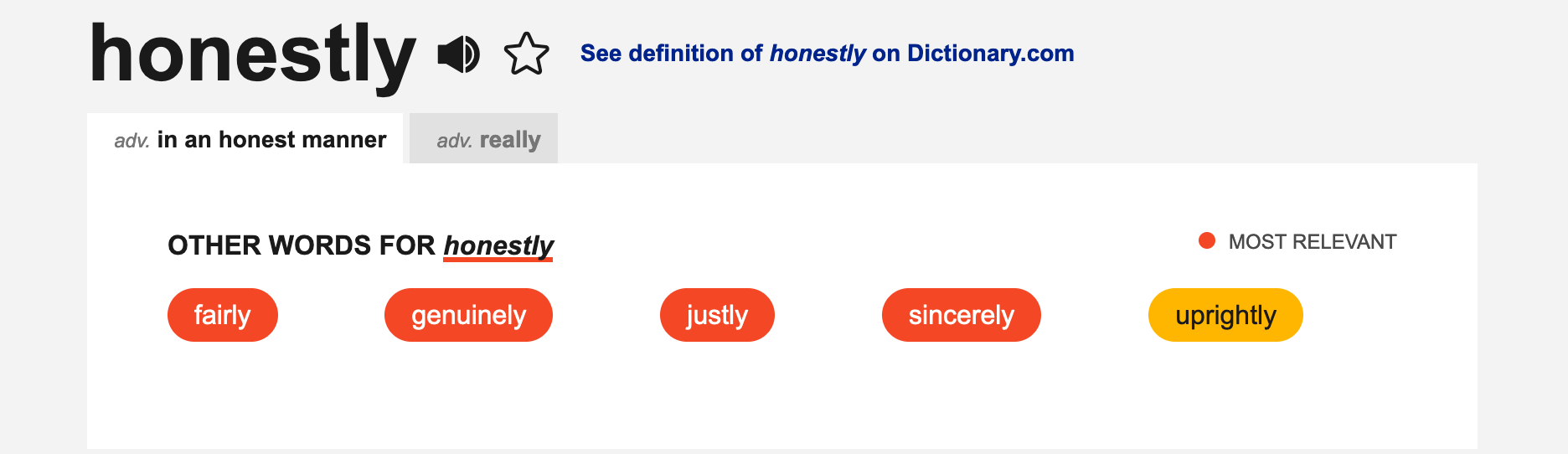
But if one considers that the word "honestly" in English can be a synonym colloquially for sincerely (as confirmed by my screenshot from thesaurus.com, then it could be argued that the point is not about honesty as much as sincerity. 

My take, for what it is worth.


Friday, January 1, 2021

The literary year 2020

Thank goodness, 2020 is done. 


Not that I believe 2021 will be back to normal (whatever that may be). The only thing I wish for is that it is not worse than 2020. Or at the very least, the beginning of the post-COVID-19 world. 


I wrote little in 2020. As is my wont (or lack of wont) when things are a bit overwhelming. However, as it also quite common, one starts the year by wanting to get back on track. A new year is as good a point as any to pick up threads again. So here I am. To ease into things, I thought I would write an easy post about my book-year 2020. 


I like lists, and keep lists of the books I read. Several lists. One is a list of books I read per year, one is my personal reading challenge (a useful tool to help me choose books, otherwise I struggle to choose). I also have a list of all books that I have ever read (as far as I have been able to recall); books by genre; books by award; and finally keep track of reading books in series or with common characters in order. I am also on Goodreads and enjoy the annual Reading Challenge there.


Yes, I like lists.

So, according to my own list, I read 131 books last year. According to my Goodreads challenge in 2020, I read 139 books. The discrepancy is due to registering novelettes online, but not on my personal list. My goal was only 100 books, but unlike an earlier year, I did not update the challenge when I reached that goal. 


In 2020 I read 73 books written by women and only 56 books written by men. I long assumed that I read more books by women than men, but when I actually counted, I found that I in fact read slightly more by men than women. That had to be remedied. I also made a concerted effort to read more translated and non-Western European authors. I read books in three languages last year - English, Norwegian and Swedish (the latter purely in audiobooks).


More specifically about books that I read last year: 


First book finished: Let it bleed by Ian Rankin.


Last book of the year: A Bali conspiracy by Shamini Flint.


Best books I read: The keeper of lost things by Ruth Hogan; Be the Bridge by Latasha Morrison; The monster at our door by Mike Davis; The riddlemaster of Hed by Patricia McKillip; Odinsbarn by Siri Pettersen.


Re-reads I loved: Taken at the food by Agatha Christie and The furthest shore by Ursula K. le Guin.


Book that surprised me: The keeper of lost things by Ruth Hogan; The lamb will slaughter the lion by Margaret Killjoy; Norge - et lite stykke verdenshistorie by Stian Bromark & Dag Herbjørnsrud; The city & the city by China Miéville; The stars are Legion by Kameron Hurley; River of teeth by Sarah Gailey; The Gurkha and the Lord of Tuesday by Saad Hossein; Hyttebok fra helvete by Are Kalvø and A man of repute by Elizabeth Edmondson.


Most challenging book to finish: Norge - et lite stykke verdenshistorie by Stian Bromark & Dag Herbjørnsrud.


Most decorated books (most literary prizes): The city & the city by China Miéville (six prizes, two shortlists and one longlist) and Every heart a doorway by Seanan McGuire (three prizes).


Number of authors I had never read before: 62


Of these, authors I look forward to reading more of: Elizabeth Edmondson, Ken Liu, Siri Pettersen, Patricia A. McKillip, Alex Gray, Martha Wells, Frank Aarebrot, Adrian Tchaikovsky, Fredrick Backman, Samantha Schweblin, Sarah Gailey, Kameron Hurley, Maria Turtschaninoff, Malin Persson Giolito and Margaret Killjoy.


Number of audio-books:  45


Books that disappointed (and that I nevertheless finished): 3001: The final odyssey by Arthur C. Clarke and The ascent of money by Niall Ferguson.


Number of books I started by didn't finish: 38. (These include some I will most likely finish in the future. One which stands out is the award winning The goldffinch by Donna Tartt, where I shared the view of a writer on electricliterature.com that the pre-Vegas part of the book is lovely, after that, I got bored). 


Making this post was considerably more challenging than before. This is my reward for not following the changes to Blogspot closely enough I suppose. 


Well, here is to a good literary year 2021, no matter what else happens. 


Oh, and happy new year! Keep safe, healthy and a good book close.


Sunday, September 6, 2020

How much longer?

Forgive me, reader, for it is a while since my last blog. 

In my defense: it has been quite a year, no? The hits just keep coming. As if the pandemic in a post-truth and science-sceptical era is not bad enough, democracy is being dismantled in the US, brick by brick, even as mamy white USians finally seem to realise that unless they do something, the disproportionate deaths of Black men in particular, will continue. I can name all too many names: Tamir Rice, Rekia Boyd, Atatiana Jefferson, Alton Sterling, Eric Garner, Trayvon Martin, Michael Brown, Philando Castile, Sandra Bland, Akai Gurley, Walter Scott, and the list goes on. 

This year, we have George Floyd, Breonna Taylor, Jacob Blake and many, many more. 

Most recently (among the better known) Daniel Prude.

WHEN WILL IT END??

At any rate, I was listening to a podcast (Poetry Magazine) and this was the poem they were discussing. Written by a Yankunytjatjara Aboriginal poet. The discussion was simply annoying, especially the point when they see the rope being pushed under the door as "blind justice". WTF? There is no justice here. Nor is there with the all to common ubiquitous execution at the hands of US police with impunity. A definite candidate for decolonisation. I would like to think the discussion would be different now.

Read, and consider. 


source: Poetry Foundation  (accessed today)


Friday, May 22, 2020

Am I an African?


Peter Tosh sings that as long as you are a black man, you are an African, no matter where you are otherwise "from". The song came up on my random music feed on iTunes and got me thinking.

I was born and raised on the African continent and have spent the better part of my life there. I lived my formative years there, and yet am I African? I am not entirely European, other than by appearance. It is complex. The term Euro-African is useful.

What I am reminded of when the question comes up, however vaguely is when I was living in Nairobi, it was my privilege to be able to hear Ngũgĩ wa Thiong'o speak. I forget the exact phrase, but what he said was along the lines that you never forget where you are from, that place forms who you are.

Whether I am African or not in the eyes of all, Africa and my efforts to deconstruct my whiteness as a white South African is probably the most significant part of who I am.

I am profoundly grateful for that and I like who those experiences have made me. I do not know what it is like to like who you are without having to put in work. I suspect that I, and those who like me who understand what the means are the richer.